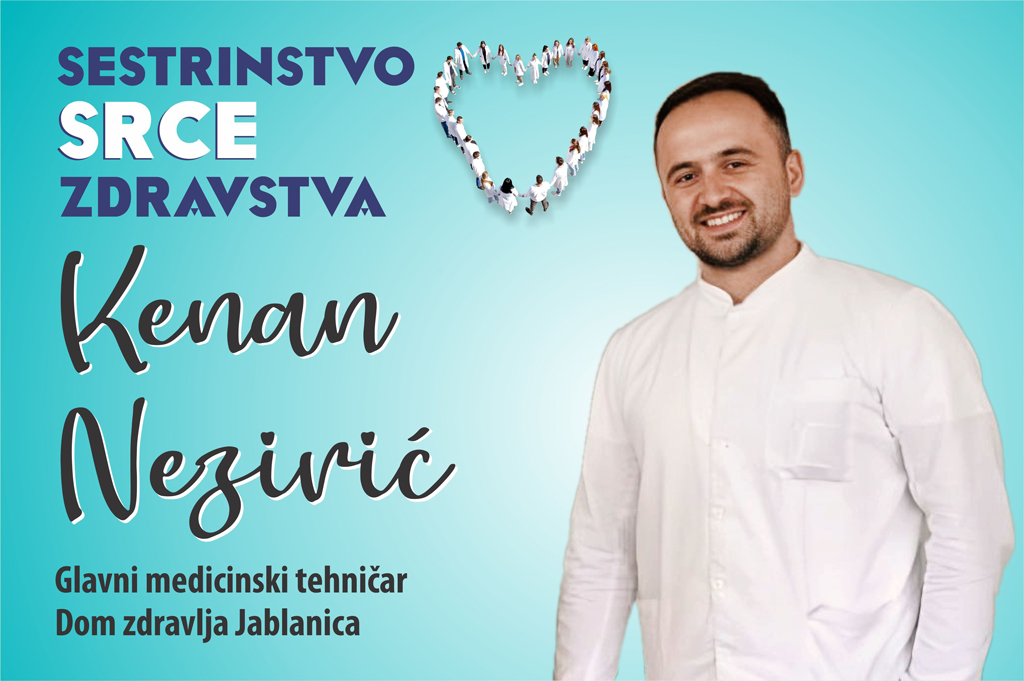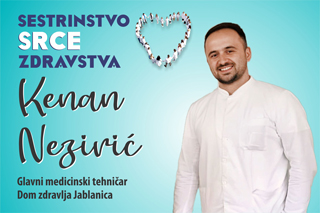
Kenan Neziric, a graduate nurse, currently holds a position of Head Nurse at Jablanica Primary Health Care Center (PHCC). His professional story shows his dedication to nursing and continuous efforts to improve nursing care in the local community.
Beginning of career and choice of profession... My first working days started at the age of 25 at the Emergency Medical Service at Jablanica PHCC. Most students at the age of 15 still do not know what they want to become in life. I was one of them, but I realized very soon, like most of my colleagues, that being a nurse is one of the most humane professions. What still inspire me are the patients' satisfaction and the idea of helping someone when they needed it the most.
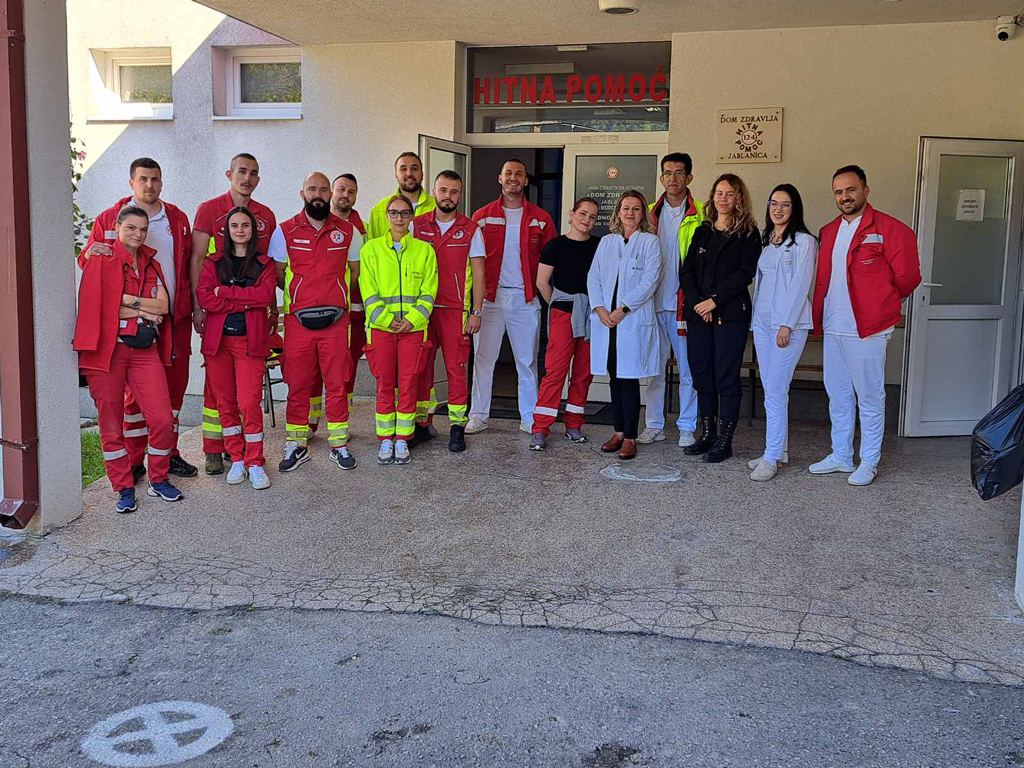
Describe your working day... There are no two same working days. Most of them are dynamic and often unpredictable, especially at the emergency medical service department, where in addition to my regular duties I spend most of my time working with patients. At the morning meetings we define the duties and priorities for that day. After that we assign tasks, organize work, coordinate between the services and send out teams to the field, including the community nursing teams. Administrative duties are an indispensable part of everyday work such as keeping documentation, records and reports. At the end of the day I create a brief review of what has been done, prepare for the next working day and leave clear guidelines to the next shift colleagues.
What part of the job people mainly do not see but is the most demanding for you? Most people only see the arrival of the team and the intervention. They do not see the pressure they are under, quick decision-making, lack of personnel and equipment, or the burden of responsibilities that they face every day. What is the least visible in this job but the most exhausting are the constant additional responsibilities. In a number of situations, in order to have a job completed on time and to have system function without interruption I also take on the tasks that are not formally in my job description. The requirement to be constantly available, to adapt and take on more than planned is an invisible part of the job which in the long run is the most draining.
What is it like to be a nurse in Bosnia and Herzegovina? Being a nurse in Bosnia and Herzegovina is unique as is the healthcare system we work in. I am glad that recently the importance of nurses has been increasingly recognized through education, training and professional workshops, and that our role is increasingly observed as one of the most important and indispensable links in the process of patient treatment and nursing care. However, in recent years we have witnessed a large outflow of educated and experienced staff. The reasons are mainly poor financial conditions and increasing workload, which is a direct consequence of the lack of staff.
What has changed at work since the first day you started till today? In the emergency medical service, the focus was primarily on the correct task performance and quick response. Today, my job is significantly different. In addition to my work with patients, it includes planning, organizing and coordinating the team, making decisions that affect the entire service, as well as responsibility for my staff, processes and continuity of work. Instead of thinking only about one intervention, today I look at the bigger picture and the long-term consequences of each decision. I see progress as the result of efforts and sacrifice, but also the obligation to justify the experience and trust gained day by day through work and relationships with patients and colleagues.
What are the shortcomings at the institution you work at? What would you change? As in most healthcare institutions, the biggest challenges we face are related to human resources. As a "small" PHCC, we often face the situation that our staff gains experience, receives additional education and then moves to a bigger healthcare institutions or cities. In addition, sick leaves and retirement of nurses further complicate the organization of work. The workload is then shared by the staff that remains in service. Under such circumstances, finding adequate replacements is extremely difficult, while the volume of work that must be done remains the same. I would like to be able to further improve working conditions in terms of infrastructure in the future. The building is older and dilapidated. Adaptation of the interior space, offices, intervention rooms and other parts we use would significantly contribute to improved quality of work and more appealing environment for patients and staff. However, it is important to emphasize that in the last few years, visible progress has been made in improving working conditions, both in terms of staff and infrastructure, thanks to the efforts of the PHCC’s management. I believe that we are on the right track.
Last year's floods in Jablanica were a major challenge for the entire community. How much did these events affect health professionals? It is difficult to describe in a few sentences all that we went through during last year's floods in Jablanica and how it affected all of us. It is a period that changed both people and the profession and will forever be remembered. The impact on health professional was manifold. When we first arrived at work, we were all in shock and disbelief, worried about our families, because we did not have any information or the possibility to get in touch with our loved ones. Unfortunately, some of our colleagues lost their family members and friends. Days were passing, full of challenges that we will never forget. Despite everything, even as a small team, we did our best providing patient care during the entire period, both in the PHCC and in the field. We spent most of our time at the workplace - some would go home just to sleep, while others worked night shifts. These events would have been a great challenge even for much larger health institutions, while for us they would have been almost impossible without the selfless support of our colleagues from Sarajevo, Mostar, Konjic and Maglaj. I would like to use this opportunity to sincerely thank them. We had teams at all accident sites, in the PHCC, as well as community nursing teams that often, under extremely difficult conditions, reached both the injured and healthy people who were in need. Difficult situations, losses and uncertainty cannot be forgotten, but at the same time they showed the strength of solidarity, unity and humanity. It was precisely in these moments that it became clear how ready health professionals are to stand by the citizens, regardless of exhaustion, fear and circumstances.
Do you think that the nursing education system in BiH is sufficiently developed? What should be improved? Personally, I believe that the nursing education system in BiH is still not sufficiently developed, but it is important to emphasize that it has been moving in the right direction in the last few years. This is noticeable throughout secondary and higher education, but also throughout employment, thanks to various training mainly organized by Strengthening Nursing in BiH project in cooperation with the entity ministries of health. I believe that nurses should have clearly and precisely defined competencies and responsibilities in practice after completing their education. Also, mentoring during education should have clearer goals and evaluation, so that knowledge is not acquired "on the fly" following the employment.
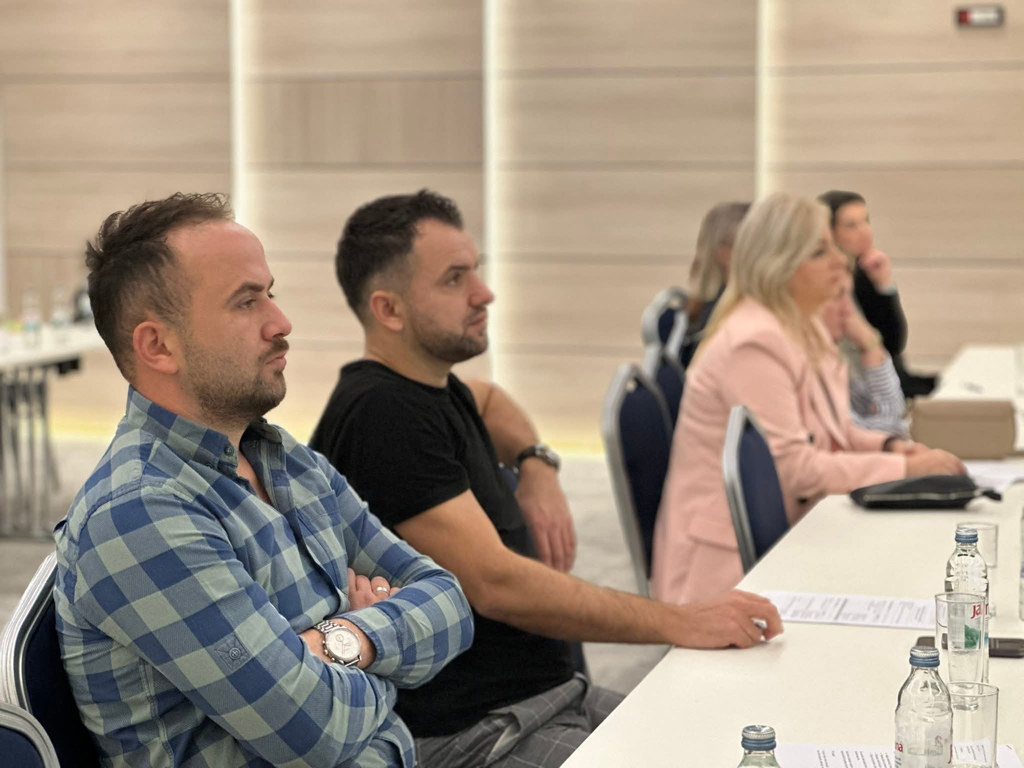
What do you remember the best from the training courses? My first encounter with Fami Foundation was about four years ago and even then I realized how much is being done for our profession through the project. I attended several training courses, workshops and programs, and I can say that in the last few years they have greatly contributed to raising the professional standards of nursing and nursing care in Bosnia and Herzegovina, in cooperation with institutions and colleagues from the country and abroad, including the Federal Ministry of Health and the Government of Switzerland. I would especially like to highlight the training course "Leadership in Nursing" held in Neum and Jahorina. During these training courses, we had the opportunity to exchange experiences with colleagues from all over BiH and jointly address topics important for personal and professional development. We continuously transfer the acquired experience to our coworkers in PHCCs, improving the practice and quality of nursing care.
A moment from your career that you will always remember... For all health professionals, Covid-19 is an unforgettable part of our career and we will surely remember it for a long time. The floods in Jablanica also left a special trace in our minds. I also remember one afternoon when the doctor, the driver and I were alone on duty and helped a woman in labor - both mother and baby were safe. Such moments remain embedded in mind forever.
What would be your message to young people who are considering a nursing career... I would like to tell everyone who like to help people, work in a team, be responsible and continuously develop, to choose this vocation - because every job that involves saving human lives makes a real sense.